Prescriptions

Ordering repeat prescriptions

We would encourage you to use online facilities to order repeat prescriptions and manage appointments where you can.

Order your Prescription via SystmOnline

The NHS APP – This is used with a smartphone or tablet – No need to contact the surgery
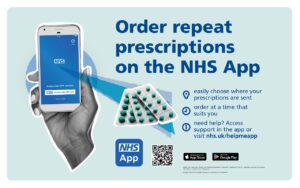
Nhs App Repeat Prescriptions Web Teaser

If you use Over Pharmacy your medications will be ready THREE full WORKING days after requesting your medication(s).

Please note Over Pharmacy is closed for lunch Monday – Friday 1pm-2pm and closed at weekends.

Using the Online systems is by far the easiest way of ordering your repeat medications and we encourage all of our patients, where possible, to do so. If this is not at all possible the pharmacy team is still helping patients to order medication through pharmacy however the NHS are phasing this out eventually.

You can also order your repeat medications by Posting your repeat slip in the box outside, if we are closed, or inside the surgery during opening hours. Ideally 7 days before you are due to run out of medication and only ordering what you need.

Please note we cannot accept repeat medication requests over the phone or on our answerphone.

Please allow THREE  full working days for prescriptions to be processed and remember to take weekends and bank holidays into account. You will also need to allow time for the Pharmacy to order your medication and dispense it safely. Please be aware that even if your medicines are available to you on a repeat prescription this still means they have to be re-ordered each month (or every 3-6 months with Contraception/ HRT) and processed, signed by a prescriber and dispensed.

The Practice does not utilise, promote, engage with or otherwise have any dealings with Pharmacy 2 U. The practice has not given consent for it’s name to appear on any of the company’s marketing material.

Medication Reviews

Medication Reviews are a way of letting our practice know how you’re managing with your long term condition, your contraception, or your medication. The aim of the review is to check that you are prescribed the most appropriate medicines for your health conditions, making sure your treatment is effective, safe and tolerated without affecting your daily routine.

All repeat medications are to be reviewed by a healthcare professional on a regular basis (every 12 months). This involves attending a medication review, either over the telephone or at the Practice.

Preparing for your Medication Review 

  1. Mark the date and time of the appointment and who you are going to talk to in your diary or calendar.
  2. Make a list of all medication that you take. This includes:
    • Any medicines that are prescribed for you (by GP, or hospital or elsewhere)
    • Any medicines that you buy over the counter from the chemist or other stores e.g. painkillers, vitamins etc.
    • Any medicines that you no longer take.
  3. You may want to make a list of questions about your medicines. Examples include:
    • Why is it important to take this medicine(s)?
    • When and how to take the medicine(s)?
    • How do I know the medicine is working?
    • What should I do if I have problems with the medicine?
    • Are there any medicines or food that I should avoid taking whilst on these medicine(s)?
    • What will happen if I miss a dose of the medicine or stop taking it?

What happens if I don’t want a Medication Review?

Medication Reviews are extremely important to ensure you are receiving the correct medication and taking it as directed. If you do not book a medication review when requested this will result in restrictions to ongoing prescription requests until such time that a medication review has been completed. This is to ensure that we are prescribing safely on an ongoing basis.

Requests for Medication to Travel

Travelling out of the country for less than 3 months:

For patients who inform us they will be out of the country for less than 3 months, we will provide sufficient medicines for an existing condition (e.g. asthma, diabetes…) for the period while the patient is away where it is safe to do so. Drugs that require frequent monitoring may not be prescribed where there are safety concerns. Supply of any medication is at the discretion of the GP.

Travelling out of the country for more than 3 months:

Patients who inform us they will be leaving the country for more than 3 months will be prescribed sufficient medication to enable them to make alternative arrangements at their destination (up to 3 months’ supply where safe to do so).

NHS Policy

By law, the NHS ceases to have responsibility for the medical care of patients when they leave the UK.  In addition GPs are not required by their terms of service to provide prescriptions for the treatment of a condition that is not present and may arise while the patient is abroad.

The NHS does accept responsibility for supplying ongoing medication for temporary periods abroad of up to 3 months. However, if a person is going to be abroad for more than 3 months, then they are only entitled (at NHS expense) to a sufficient supply of regular medication in order to get to their destination, where they should then find an alternative supply of that medication.

Patients residing abroad for a period of more than 3 months should be removed from the registered patient list.

Advice if travelling outside the UK with medicines

  • Only take enough medicines for your own needs.  Do not take excessive quantities.
  • Medicines need to be carried on the person i.e. not in luggage that goes into the hold
  • All medicines should be in the labelled containers they were dispensed in by the pharmacy
  • Carry a copy of an up to date repeat list
  • Other countries have their own import laws for prescription medicine and controlled drugs.  You could get a fine or go to prison if you travel with medicine that is illegal in another country. Check with the embassy of the country you’re going to before you travel or your travel agent may be able to assist with advice.

Shared Care Medications

What is a Shared Care Agreement?

Shared Care is when a Specialist asks a GP practice to take on responsibility for prescribing and monitoring medications usually only issued by Specialists. This might happen if you have been referred for a specific issue and a Specialist has made a diagnosis and put a treatment plan in place.

These agreements require all parties to accept shared care, and the ultimate responsibility for prescribing and monitoring remains with the Specialist.

I’ve been seen by a specialist and have been advised my GP will prescribe the medication, when can I expect my prescription?

Your medication will be commenced by your specialist until such time the medication is stable, at this point your specialist will write to us for consideration in taking over the prescribing, this process can take up to 2 weeks (once we have received the paperwork from the clinic), in the meantime your specialist can continue your prescriptions.

Patient Responsibilities whilst under a Shared Care Agreement 

It is important to understand your role in the Shared Care Process. Most Shared Care Drugs have to be closely monitored, therefore you will be called in for regular blood tests, Blood Pressure, BMI checks (depending on the medication requirements).

It is imperative that you comply with these requests and keep up to date with your monitoring, failure to do so will effect the practices ability to safely prescribe the medication and may mean that we have to return your care back to your specialist.

I am under a Private consultant, can my GP take over prescribing and monitoring?

If specialist care is accessed privately, it is the responsibility of the private clinician to provide prescriptions. If medication is intended to be prescribed long-term a private specialist may request that it is taken over by a GP. There is no obligation for GPs to prescribe a medication that was started by another clinician and a GP must be satisfied that any prescription is safe and appropriate, and in line with NHS guidelines and their prescribing competencies.

Medications started privately will only be continued to be prescribed by a GP if they are:

a) in line with NHS treatment guidelines

b) align with the local prescribing policy

c) are deemed to be safe and appropriate for the patient being treated

d) might normally be prescribed by a GP (i.e. not a specialist medication)

Some specialist medications (e.g. stimulants for ADHD, immunosuppressants, hormones used in gender affirming treatment) require a “shared care agreement”. This allows GPs to prescribe specialist medications under the oversight of a specialist, who continues to review the patient’s treatment. Although there are established local shared care agreements with NHS specialists, these are not in place for private prescribers and so we do not accept shared care agreements with private specialists. This means that any medication requiring a shared care agreement that is initiated by a private clinician will need to be prescribed directly by that clinician.

If I pay for my own Private prescription can I have my blood tests done at the practice?

Unfortunately not, this is because our clinical staff are only indemnified to undertake NHS work, we do not have additional cover to provide non-NHS Blood tests

Could the Doctor not just request the tests on the NHS?

The clinician requesting pathology remains clinically responsible for any results received. Patients under NHS Shared Care Agreement’s are jointly monitored by the GP under the direction of a specialist, whereas Private Medications are not. GP’s are not indemnified for monitoring Non-NHS Medications.

Queries about your medication

If you wish to speak to a pharmacist for advice on medicines or other queries, please telephone: 01954 233457 after 09:00am.

Please do not use this number to order repeat prescriptions.

Pharmacy services

Find a local pharmacy